Back to Home page - Monsegur Vaillant - Unique interprète s'accompagnant elle-même!From Paris to Moscow through Cluj-Napoca Romania and ZwickauOur CDsOur Books


English
 
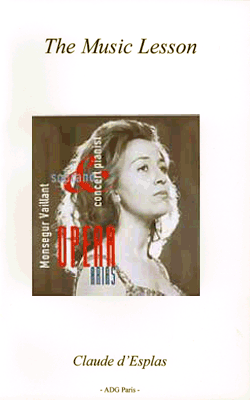
the Music Lesson by Claude d'Esplas

The Music Lesson


Claude d'Esplas


Franz Peter Schubert, Bicentenary (1797-1997)


Franz Peter Schubert, Bicentenary (1797-1997)

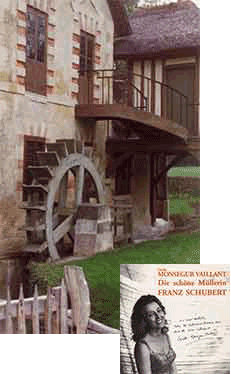
Die schöne Müllerin (The Fair Maid of the Mill) Franz Peter Schubert

The Poet’s Prologue

"I invite you, Ladies fair and Men of Taste
And all who like to see and hear something new;
To listen to a brand-new show
That’s written in the very latest style…"
Wilhelm Müller

         Once upon a time, there was a fairhaired miller’s lad, honest, naïve, drunk with fresh air and space, who fell in love with his master’s pretty daughter, a beautiful young lady with blue eyes. Destiny assigned them a tryst on the bank of a fresh stream, eternal confidant, eternal traveller, in the heart of the green countryside of Austria. The miller’s apprentice was direct, the young lady coquettish ; she showed herself more accessible to the calling of the horn (‘you call that art !’, Schubert said to one of those ‘blowers of the wind’ in the Vienna Opera orchestra) than to the quivering of her lovesick lover’s lute. Hence, the coquettish lady will forget the crystal-clear water where The Trout wriggles, the smell of fresh-cut hay, the moon and the stars, the immense sky, and this in order to crane her neck all the better towards the highway which leads towards the town, where a braggart is walking past with his gun and laden with the skins of innocent game, thus provoking the desperate deed from the poor miller’s apprentice who is turned down by his socially not so humble lover.

         One remembers how – at least according to legend – Franz Peter Schubert, visiting his friend, the singer Randhartinger, surreptitiously borrowed a collection of poems left lying on the table: they were Die schöne Müllerin by Wilhelm Müller, poet, specialist in philology, in old languages, in history and fervent reader of Shakespeare, Wilhelm Müller, who, with this cycle, wanted to find again the spirit of Volkslied, such as it descended from the Minnesänger (the Minstrels), if not from the Troubadours, and who had hoped very much (1827) that the ear of a kindred spirit would catch, some day, the melodies from his words and who would give him back his own, not knowing that Schubert had already done so.

         It is well-known how, next morning (by way of excuse ?) Schubert sat down at the piano in front of Randhartinger and with his pleasant tenor voice, accompanying himself, sang to him some of these fresh-blown melodies, drawn from the collection in question. The poet and the composer never met. What would, therefore, Müller have written to Schubert, if he had heard his Schöne Müllerin such as it is told to us here, in a succession of small lyrical dramatic pictures, spontaneous expression of the Germanic soul, if not of simply the soul, by an interpreter whose nationality is: Musician.

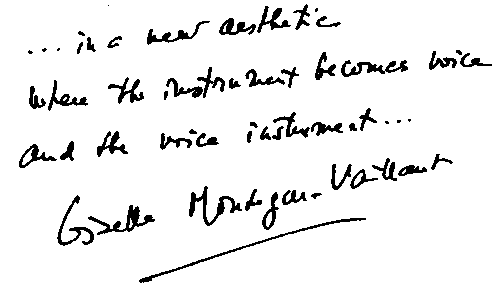
         But let us leave it to the interpreter to excuse herself – in her turn: ‘where is the achievement ? You will ask. There is no achievement. It is only a matter of approaching the original intention, that of the poet as much as that of the musician, and, by forgetting oneself, to meet one and the other separately, then together, in their quest of the absolute, at the very end of a new aesthetic where the instrument becomes voice and the voice instrument…’

         Even if Schubert was perfectly conscious of his limitations as a pianist (in this connection, compare the Erlkönig of May 8, 1993, Rachmaninoff Hall, Moscow) , even if Müller admitted that his Lieders only lead to one half of life, a paper life in black and white, until music animates them – nature and art, which according to the happy formulation of Goethe seemed to flee each other, here, at last, seem to meet at the end of a possible elegiac homage of the revolutionary Clairette to the Austrian ‘Schöne Müllerin’ of the Petit Trianon.

CLAUDE D'ESPLAS - The Music Lesson
ALL RIGHTS RESERVED


Share


Recent Upgrades :An die Musik (Schubert / Schober), An die Musik Biography 2010, Fleur jetée / Armand Silvestre - Tarascon sur Ariège, Le temps des roses (Camille Roy/Charles Gounod), Villanelle (Théophile Gautier/ Hector Berlioz), Chevaux de bois (Paul Verlaine / Claude Debussy), La Mimine (french, english, german), D'un moulin l'autre... (french, english, german), Am Meer - Schwanengesang (Franz Schubert / Heinrich Heine), Alan Blyth, music critic, Fleur jetée (Fauré, Armand Silvestre), Ballade du Roi de Thulé - Faust / Gounod, An die Musik - Schumann, Der Jäger, Burya, Der Leierman, Uno maitinado fresco, Colombey-les-deux-Eglises, Arion (Rachmaninov, Aivazovsky), Der Wanderer (John Keats), Fleur jetée (english, french), Die Post (engraving), Dunsa Manor The Dogs (english, german), Catéchisme Poissard (english, german), Arsinoé (english, german), Chosibus (english, german), Siren' - Lilacs, An den Sonnenschein, Volksliedchen Op.51 n°2 (Rückert/Schumann), Veter perelyotnïy - A passing breeze, Die Rose, die Lilie … - Dichterliebe Op.48 (Robert Schumann / Heinrich Heine), Ich grolle nicht - Dichterliebe Op.48 n°7 (Robert Schumann / Heinrich Heine), Frühlingsnacht - Liederkreis Op. 39 (Robert Schumann / Joseph von Eichendorff), Frühlingsfahrt Op. 45 n°2 (Eichendorff/Schumann), Volksliedchen Op.51 n°2 (Rückert/Schumann), Stille Tränen Op. 35 n°10 (Kerner / Schumann), Die Junge Nonne Op.43, n°1 (Schubert/Craigher), Impromptu n°3 La Bémol Majeur Opus 34 - Gabriel Fauré - Maly Hall April 30th 1993 Tchaikovsky Conservatoire, Impromptu n°2 op.31 en fa mineur (Gabriel Fauré) - Maly Hall - April 30th 1993 Tchaikovsky Conservatoire - Moscow, Nocturne n°4 Mi Bémol Majeur Opus 36 - Gabriel Fauré - Rachmaninoff Hall - May 8th 1993 Tchaikovsky Conservatoire - Moscow, An die Musik (Franz Schubert / Franz von Schober), To the children - Детямv - Aux enfants (Rachmaninov / Anton Khomyakov), Observatoire de Meudon, février 1748 (french, english, german), Cosi fan Tutte ou Maria Aparatchika en Bohème (english, german),

ADG-Paris © 2005-2011
Bon sites
Statistiques et PageRank sur DACODAC.FR     |     TrOOv, Annuaire et Moteur de Recherche Francophone     

00037495

Site Web déposé :
Livres déposés :

Creation Site Internet (site vitrine, e-commerce, site pour artiste, phototheque,...) Paris, Référencement et hébergement internet ASP/PHP - Webmaster, Webagency Paris Neuilly Orleans Pithiviers Rennes, Hebergement et Referencement    Annuaire des Meilleurs Sites Francophones Annuaire des Meilleurs Sites FrancophonesAnnuaire des Meilleurs Sites Photo Vidéo Francophones - Annuaire des Meilleurs Sites Web Francophones - TROOVETOO
monsegur-vaillant.com, adg-paris.org available at adg-paris.com, claudedesplas.com and adgparis.com

Creation Site Internet (site vitrine, e-commerce, site pour artiste, phototheque,...) Paris, Référencement et hébergement internet ASP/PHP - Webmaster, Webagency Paris Neuilly Orleans Pithiviers Rennes